What is an FCU?
- A stand-alone HVAC unit that heats or cools a single room.
- Pulls room air in → moves air across a coil → supplies conditioned air back to the room.
- Unlike an AHU, an FCU does not require ductwork and serves individual spaces.
FCU vs AHU
| FCU | AHU |
| Serves single rooms / localized control | Serves multiple rooms / entire buildings |
| Small, room-based, decentralized | Large, centralized (roof/basement/mechanical room) |
| Recirculates air within a space (no duct system needed) | Delivers conditioned air via ductwork |
Main Components of an FCU
- Blower - Draws in room air & pushes it across the coil.
- Motor - Powers the blower for air circulation.
- Coils (Cooling / Heating)
- Cooling coil uses chilled water from a chiller.
- Heating coil uses hot water from a boiler or electric heating.
- Filter – Traps dust, insects, and debris; protects the coil.
- Must be replaced regularly to maintain efficiency.
- Drain / Condensate Pan – Collects water that forms on the cooling coil, preventing damage and mold.
- Actuator Valve – Controls water flow through the coil → regulates temperature.
- Thermostat – Adjusts temperature, operation mode (cool/heat), and fan speed (low/medium/high).
- Air Vents (Return & Supply)
- Return: Air intake to the FCU
- Supply: Conditioned air discharged back to the space
Where FCUs Are Commonly Used
- Hotels
- Apartments / Condominiums
- Small offices
- Any building requiring individual room temperature control
How an FCU Operates (Process Flow)
- Blower pulls room air through the return vent.
- Air passes across the cooling or heating coil.
- Air temperature changes based on chilled water / hot water / electric coil.
- Conditioned air is supplied back into the room via the supply vent.
- This cycle repeats until set temperature is reached.
- FCUs can be two-pipe or four-pipe, which determines cooling/heating changeover capability (covered in the next lesson).
FCU Mounting Configurations
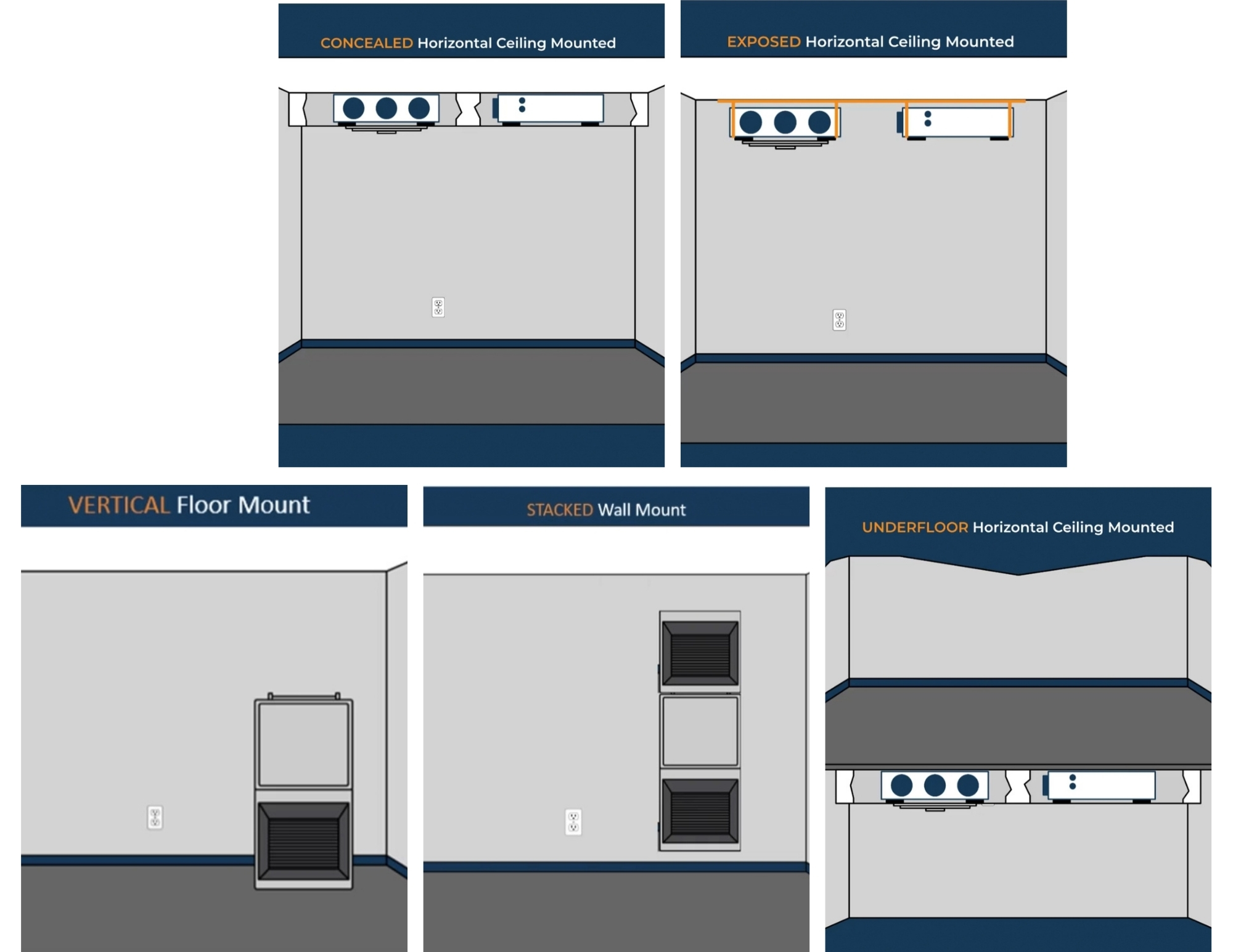
- Ceiling-Mounted Concealed FCU
- Common in offices with drop ceilings
- HVAC components hidden above ceiling tiles
- Supply/return air via ceiling grilles & ducts
- Quiet operation, less visible → good for aesthetics
- Ceiling-Mounted Exposed FCU
- Found in open-ceiling, modern/loft-style offices
- Mechanics remain visually exposed as part of design
- Air may be delivered via ducts or directly from unit
- More noise due to exposed structure
→ must consider acoustic impact
- Wall or Floor-Mounted FCU
- Typical in hotels, apartments & small living spaces
- Bottom grille = return air intake
Top grille = conditioned air discharge - Pros: Easy access, simple maintenance & inspection
Cons: Occupies wall/floor space
- Floor-Mounted Concealed / Underfloor FCU
- Less common; mostly used in data centers
- Provides flexible spot-cooling for IT equipment racks
- Uses floor grilles and ducts for airflow distribution
Two-Pipe vs Four-Pipe FCU Systems

Two-Pipe System (Single Loop)
- Coil handles either cooling OR heating at a time
- Requires seasonal changeover (heating ↔ cooling)
- Lower installation and piping cost
- Less flexibility in mixed-season conditions
Four-Pipe System (Dual Loop)
- Two loops: Chilled water + Hot water
- Can heat and cool simultaneously, no seasonal switch needed
- Higher complexity and higher installation cost
- Best comfort performance → independent temperature control year-round
Installation Codes & Regulatory Standards
- FCU installs must comply with national, state, and local codes
- Key governing standard: NEC (National Electric Code)
- Final compliance checked by AHJ (Authority Having Jurisdiction)
- Following code ensures safety, performance, and reliability
Advantages of FCUs
- Easy to retrofit / add to existing spaces
- No ductwork required → lower installation cost
- Minimal disruption when adding cooling to a room
- Simple maintenance & replacement
- Serviceable without shutting down building systems
- Straightforward operation → easier troubleshooting
- Individual room control
- Each space can be set to a preferred temperature
- Example: Office cooler for focus vs home warmer for comfort
- Energy savings
- May reduce heating/cooling cost up to ~20%
- Only conditions occupied rooms → avoids wasted energy
- Improved air quality
- Filters capture dust/pollen → helps reduce allergy symptoms
Disadvantages of FCUs
- High long-term maintenance burden
- Each FCU needs regular service
- Filter changes, actuator replacement, condensate pan repairs
- More units → higher cumulative maintenance cost
- Maintenance often occurs in occupied rooms
- Work has to be done inside offices, hotel rooms, meeting rooms
- Proper sizing is critical
- Undersized unit → runs harder → more energy use
- Oversized unit → short cycling → temp swings & inefficiency
- Possible temperature imbalance
- Uncoordinated FCUs may conflict with each other
- Hot/cold zone differences increase energy use
- No fresh air supply
- Recirculates room air only
- A separate ventilation system is required for outdoor air
- Noise concerns
- Can disrupt quiet environments
- Causes: improper install, old motors, unbalanced fan blades, speed changes
'HVAC Fundamental (English)' 카테고리의 다른 글
| Residential Ductwork Fundamentals: Layouts, Materials, Fabrication, and Installation (0) | 2025.12.14 |
|---|---|
| Introduction to Exhaust Fans (0) | 2025.12.08 |
| Compressor Types: Best Use Cases (0) | 2025.06.04 |
| HVAC Thermodynamics Basics (0) | 2025.06.01 |
| Single-Phase Motor Reverse Rotation: Causes & Fixes (0) | 2025.05.31 |